Shadow AI: Digital Transformation Happening Without a Strategy
When artificial intelligence comes before strategy
For many years, the adoption of new technologies has followed a rather predictable path. The company identified new software, involved the IT department, defined procedures, organized training and only then did employees start using it. Innovation was a process planned, governed and distributed from above. Something different is happening with artificial intelligence. Today, tools like ChatGPT, Claude, Gemini and many other platforms are used spontaneously by millions of professionals to write emails, summarize documents, prepare presentations, analyze data or generate code. Very often this adoption occurs before the organization has defined a strategy, an internal policy or a dedicated training path. In other words, AI enters companies through people, not through digital transformation processes. It is precisely this reversal of the traditional adoption path that has given rise to an increasingly widespread phenomenon: Shadow AI.
What is Shadow AI
The term Shadow AI refers to the use of artificial intelligence tools by employees without the company being fully aware of it, having authorized it or is monitoring its use. This is not necessarily intentional misbehavior or a violation of the rules. In most cases, it’s simply because the rules don’t yet exist, are unclear, or can’t keep up with the speed at which these tools are transforming everyday work. Every day documents, emails, presentations, contracts, commercial offers and company data are uploaded to the AI platforms with the aim of working faster. Those who use these tools often do not perceive that they are introducing a new technology into organizational processes. They are simply looking for a more efficient way to do their job. And it is precisely this normalization of artificial intelligence that makes the phenomenon so significant.
A phenomenon that is much more widespread than it seems
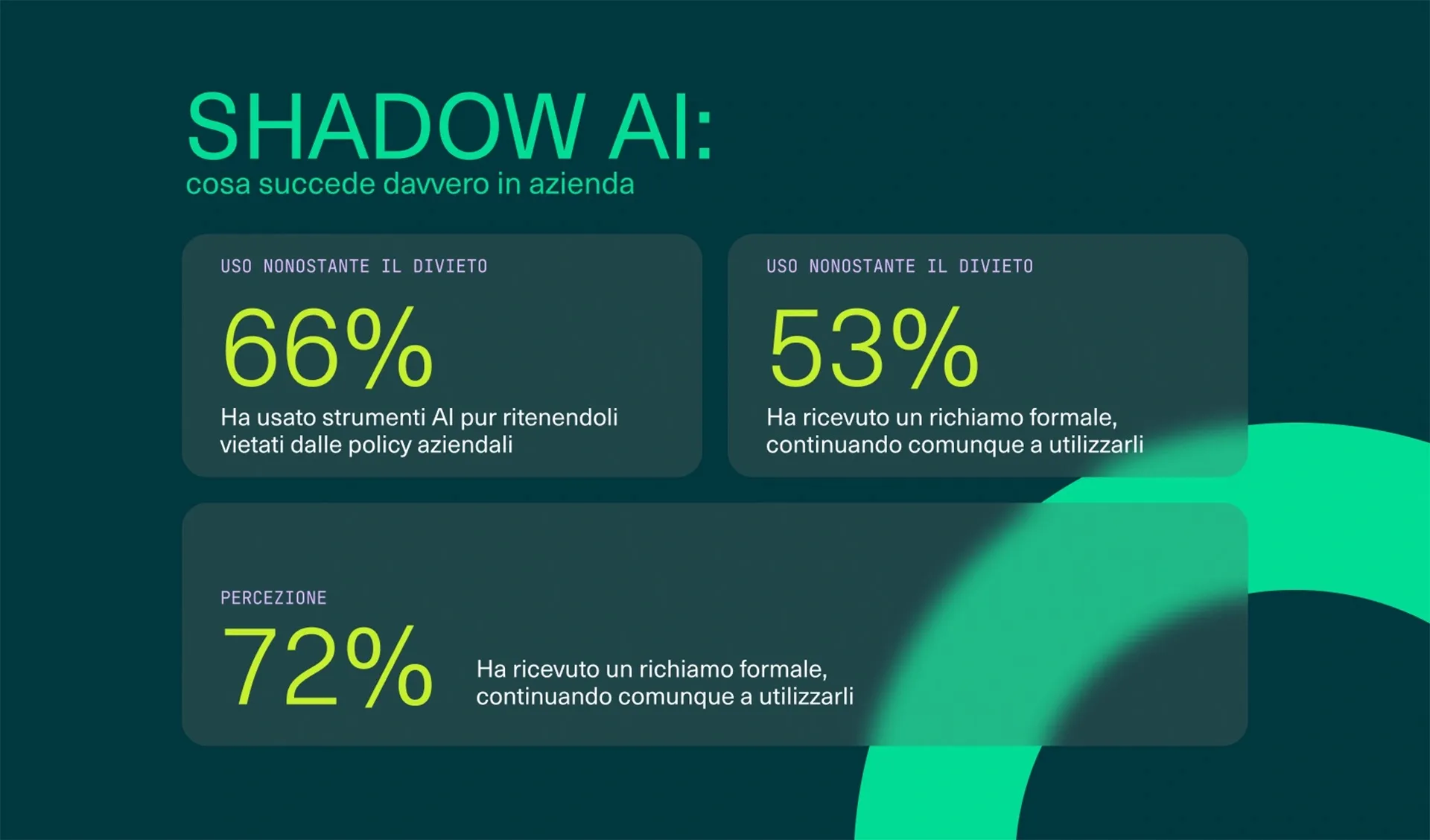
The most recent research also confirms that Shadow AI is not a marginal phenomenon. According to a study carried out by PagerDuty in 2026 on a sample of 1,250 professionals, 66% of employees have used artificial intelligence tools even though they considered them prohibited by company policies. Even more significant is the fact that over half (53%) received at least one formal warning for this behavior, but continued to use these tools. The data tells a precise reality: the ban, alone, rarely changes work habits when people perceive a tool as useful or necessary. The research also highlights another particularly delicate aspect. 43% of respondents say they have inserted company emails into public AI platforms, 34% have uploaded customer data and 31% have shared confidential documents. These actions do not always result from negligent or intentionally incorrect behavior. Much more often they are the consequence of the absence of clear rules, a lack of training or the difficulty of organizations in keeping up with the speed with which these tools are entering daily work. Finally, there is a fact that helps to understand the extent of the cultural change underway: 72% of professionals believe they understand artificial intelligence better than their IT team. Whether or not this perception corresponds to reality is almost secondary. The point is that, for the first time, a technology is spreading from the bottom up. People adopt it spontaneously, while organizations still try to define its rules, processes and responsibilities. It is precisely this gap between speed of adoption and governance capacity that makes Shadow AI one of the main organizational challenges of the artificial intelligence era.
The problem is not AI. It’s AI without governance.
The spread of Shadow AI often leads to a hasty conclusion: the use of these tools must be limited or prohibited. In reality, the problem is not artificial intelligence itself. The risk arises when its use occurs without shared criteria, without training and without any supervision. In this scenario, very different situations can arise: company data uploaded to external platforms without prior evaluation, documents generated automatically and sent to customers without verification, decisions made on the basis of output that has never been validated or completely different uses of the same tool between different departments. The absence of governance makes it difficult to understand which tools are actually used, for what purposes and on what types of data. Shadow AI therefore becomes first and foremost an organizational problem, much more than a technological one.
Why banning AI rarely works
Faced with this scenario, some companies have chosen the simplest path: blocking access to public AI tools. It’s an understandable reaction, but rarely a decisive one. When a technology is perceived as useful for working better, people still tend to look for alternatives. They use personal devices, private accounts or tools other than those officially authorized. The result is paradoxical. The company does not eliminate the phenomenon. He simply loses the possibility of observing it. It is a dynamic already seen in the past with cloud storage, messaging applications or the so-called BYOD (Bring Your Own Device). When demand for a tool grows faster than the organizational capacity to manage it, the ban tends to move the problem outside the scope of control, not solve it.

From Shadow AI to AI Governance
For this reason, more and more organizations are shifting their focus from control to governance. Governing artificial intelligence doesn’t mean monitoring every single prompt or limiting people’s autonomy. It means creating a context in which tools can be used in a coherent, safe and aligned way with company objectives. An AI Governance strategy generally starts from three fundamental elements. The first is to understand what is really happening within the organization: which tools are being used, by whom and for which activities. The second concerns the definition of simple and shared policies, capable of clarifying which data can be used, which tools are authorized and which procedures to follow in different operational contexts. The third element is training. Because no rule can be truly effective if people do not understand the opportunities, limits and responsibilities associated with the use of artificial intelligence.
The AI Act makes governance a responsibility
Regulatory evolution further strengthens this perspective. With the entry into force of the European AI Act, the management of artificial intelligence no longer represents just an organizational choice oriented towards efficiency. For many companies it also progressively becomes a question of compliance, responsibility and risk management. Organizations are called to know the AI systems used in their processes, to evaluate their impacts and to prepare adequate control, training and documentation measures, especially in the most sensitive use cases. In this context, not knowing that AI is being used within the company is no longer a neutral position. It becomes a factor of vulnerability.

The first step is to know what is happening
Before introducing new platforms, defining policies or investing in training, it is necessary to build a snapshot of the current state. What tools are collaborators already using? For which activities? What data is shared? Which departments have already integrated AI into their daily activities and which have not yet started? Only starting from this awareness is it possible to plan a truly effective adoption path. In the work we carry out at BOOONSAI, this is the starting point of each project. In fact, we help companies to map the presence of artificial intelligence within the organization, define a governance model and accompany people and processes towards a more aware, controlled and sustainable use. Because today the question is no longer whether AI has already entered your company. The question is whether your company is ready to govern it.