AI Adoption in Triveneto SMEs: Launching a Survey on the Real State of Artificial Intelligence in Companies
Artificial intelligence has entered Italian companies without going through the usual channels of technological innovation. It did not arrive through an approved project, a dedicated budget, or a shared adoption plan. It came in through people: a colleague using a generative assistant to prepare a document, a team trying a tool to synthesise information, a manager discovering a faster way to handle a recurring task.
This pattern of diffusion has a precise consequence. Within the same organisation, very different levels of use coexist: people who have built a personal method and get concrete results, people who stopped after a disappointing first attempt, and people who have never tried. Tools are chosen individually, often with personal accounts, without shared criteria on which information can be entered and which cannot. Written rules are rare, and an overall view of what is happening is rarer still.
The result is that artificial intelligence is already part of everyday work in many companies, but few know exactly in what form. There is a lot of talk, plenty of analysis and forecasts, and ongoing debate about transformation and opportunity. What is missing is the data: what is really happening inside a company, which tools are being used, which activities produce a measurable benefit, and where people instead run into difficulty.
Why we launched this survey
This gap is especially clear in our territory. Triveneto is largely made up of specialised small and medium-sized enterprises, with lean organisational structures and processes built over time around specific skills. It is a productive context with its own characteristics, and how artificial intelligence is entering this fabric has never been observed systematically.
That is where the survey we are launching today comes from. It has a dual objective, which we state openly. On one side, to return a useful picture: to participating companies, about their own organisation, and to the territory, in aggregated form. On the other, to understand the ecosystem we work in more clearly, because knowing the real state of AI adoption in the companies we deal with every day makes our work more precise.
Who is running the survey and what it measures
The survey is promoted by BOOONSAI, an artificial intelligence consultancy based in Padua, with the support and supervision of lawyer Andrea Rinaldo, a lecturer at the University of Padua.
The study looks at six dimensions of artificial intelligence use within company teams:
- Diffusion, how many people use AI tools and how often
- Tools in use, which platforms are actually adopted and with what type of account
- Use cases, which activities artificial intelligence is applied to in day-to-day work
- Results, where use produces a recognised benefit and where the outcome is instead seen as unsatisfactory
- Difficulties, where people hit obstacles, what they try without succeeding, and where they spend more time than necessary
- Internal rules, whether shared criteria exist on tool use and on which data can be entered
Methodologically, the survey is run through a structured questionnaire administered to company teams. Responses are processed at the level of each organisation and then aggregated across the overall sample.
Who it is for
The survey focuses on small and medium-sized enterprises in Triveneto, according to the European definition that places this category under 250 employees.
There are no sector restrictions. The condition instead concerns the nature of the work observed: the study concentrates on knowledge-worker teams, groups of people whose daily activity mainly involves documents, data, content, and relationships. These are the contexts where generative artificial intelligence has the most relevant effects, and where measuring its diffusion makes sense.
It is not required that artificial intelligence already be in use. The absence of adoption is also a relevant data point for the survey, and understanding why these tools have not entered some organisations is part of what we want to observe.
The company contact who joins on behalf of the organisation must have a mandate over the team involved in the survey.

How to take part
Participation happens through the AI Assessment, the tool used by the survey to collect data from companies in the sample.
Goals and timeline
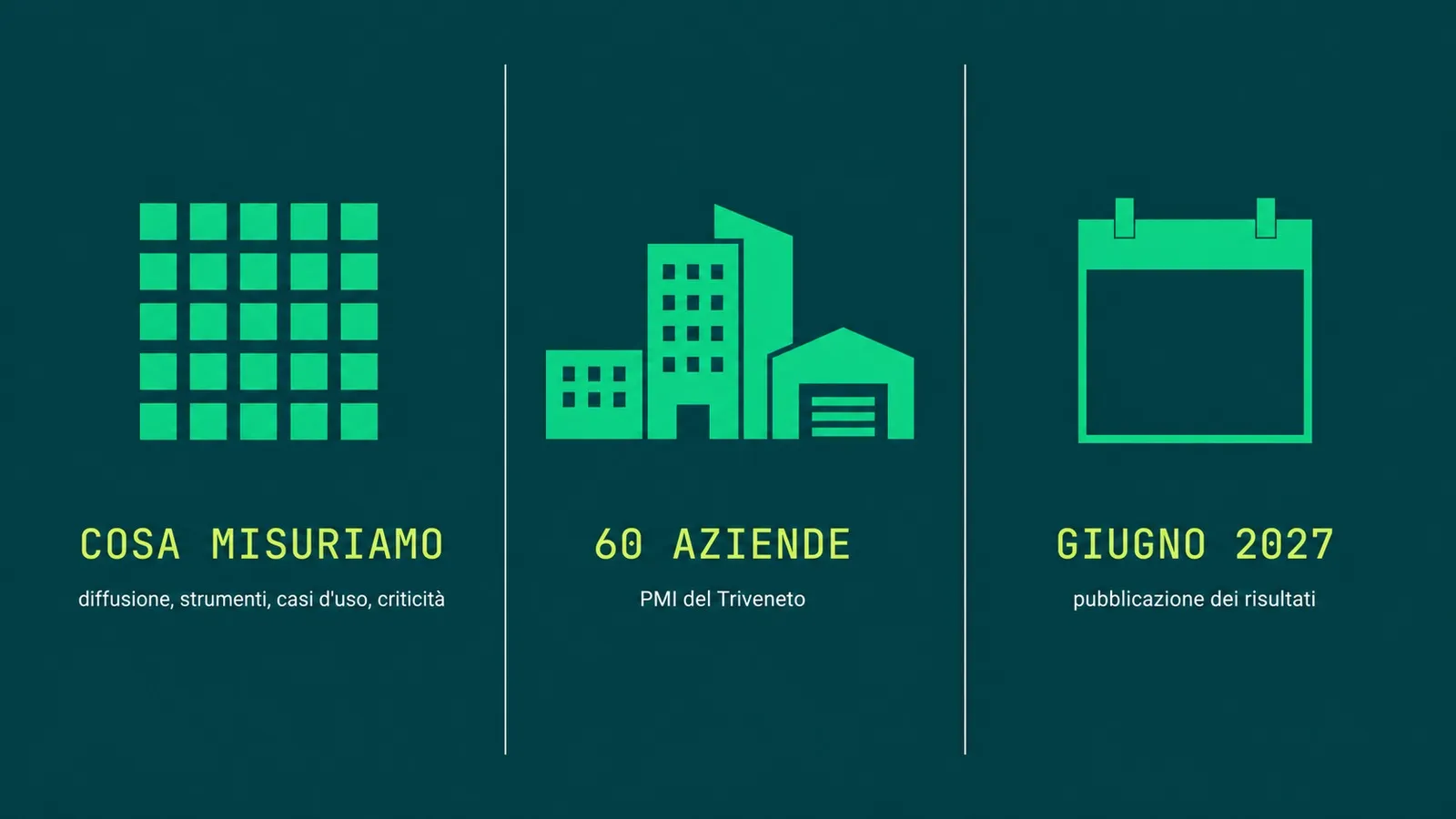
The survey aims to involve 60 companies in the territory. Data collection will continue until this goal is reached, with results expected to be published around June 2027.
How we handle the data
Employees complete the questionnaire anonymously. Names are not collected, and no individual answer is shared with the company: organisations receive only aggregated data about their own team.
Likewise, the data that feed into the survey are aggregated, and the names of participating companies do not appear in the final report.
One clarification we consider necessary: the questionnaire does not evaluate people. It does not measure individual skills or produce internal rankings. It captures a collective state at a precise moment, and that is its only purpose.
For information
For any question about the survey, the method, or how to take part, write to info@booons.ai.